
Manufacturing AI Development Company
Building AI systems that turn plant floor data into predictive maintenance, quality control, and production efficiency manufacturers can measure.
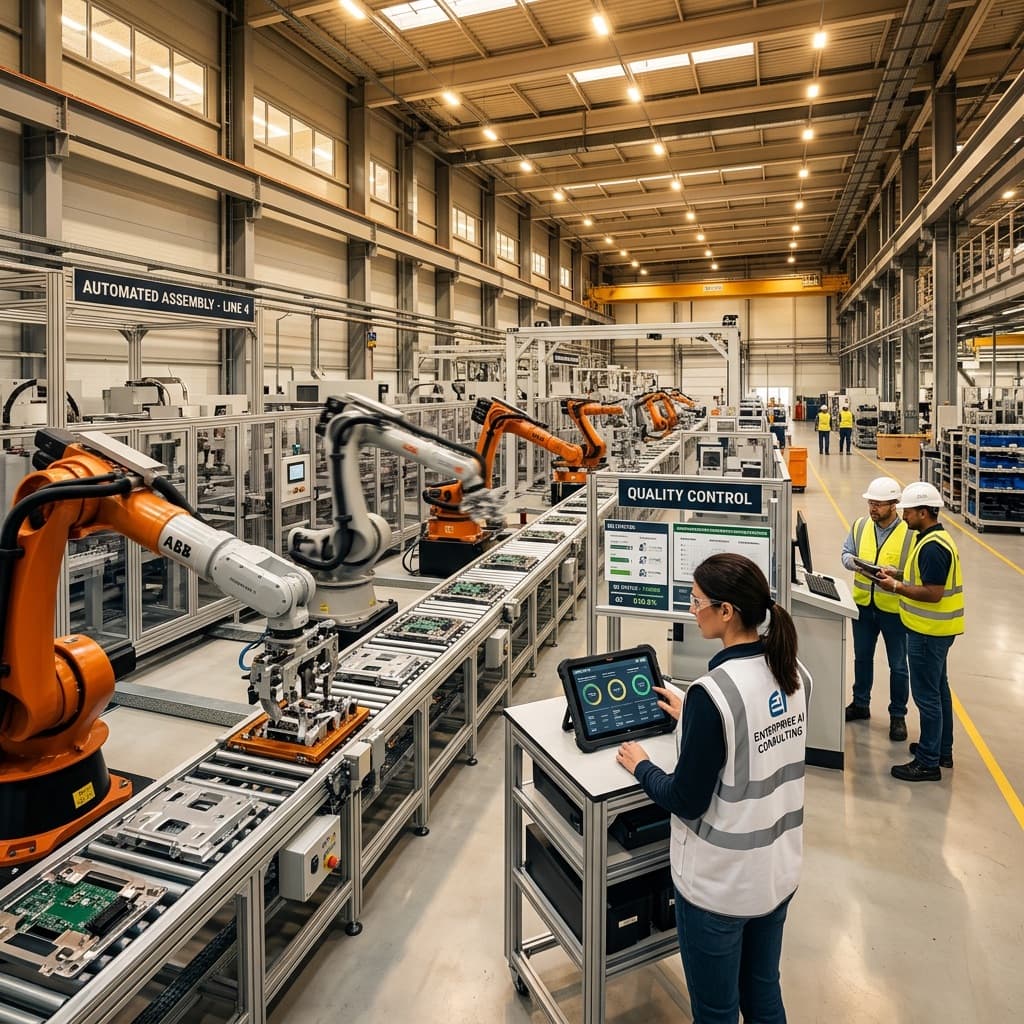
As a trusted manufacturing AI development company, Antier partners with plant operations leaders and industrial enterprises worldwide to deploy AI across production, quality, maintenance, and supply chain operations.












AI Solutions Built for Manufacturing Operations
From predictive maintenance to plant-floor automation, we develop AI solutions that address the operational realities of modern manufacturing environments, not generic AI capabilities retrofitted for the plant floor.
Predictive Maintenance
We build predictive maintenance systems that analyze vibration, temperature, acoustic, and historian data from production equipment to flag developing failures before they cause unplanned downtime. Machine learning models trained on your equipment's failure history and sensor patterns help maintenance teams move from fixed-interval servicing to condition-based interventions.
Computer-Vision Quality Inspection
Our computer-vision quality inspection systems detect surface defects, dimensional deviations, assembly errors, and packaging inconsistencies at line speed, augmenting or replacing manual visual checks. These systems learn from labeled defect images specific to your products and materials, improving detection accuracy as more inspection data becomes available.
Production Planning & Scheduling Optimization
We develop AI-driven scheduling engines that optimize production sequences, changeovers, and resource allocation against constraints like machine capacity, labor availability, and order priority. These systems continuously re-optimize schedules as conditions change, helping planners respond to disruptions without manually rebuilding the production plan.
Supply Chain Demand Forecasting
Our demand forecasting models combine historical sales data, market signals, and supply chain variables to project demand at the SKU and plant level with greater accuracy than traditional statistical methods. Better forecasts translate into tighter inventory levels, fewer stockouts, and more efficient raw material procurement.
Digital Twins
We build digital twins that mirror physical production lines, equipment, and processes in a virtual environment, allowing engineering and operations teams to simulate changes, test failure scenarios, and validate process improvements before touching the physical line. Digital twins connect to live plant data so the virtual model reflects actual operating conditions.
Plant-Floor Automation & Robotics Coordination
Our AI development services extend to coordinating robotics, automated guided vehicles, and programmable equipment across the plant floor, helping disparate automation systems work from a shared, AI-informed operational picture. This reduces manual coordination overhead and improves throughput across multi-cell and multi-line environments.
Energy & Resource Optimization
We develop AI models that monitor and optimize energy consumption, compressed air usage, and resource allocation across production lines, identifying inefficiencies that are difficult to detect through manual monitoring. These systems help manufacturers reduce utility costs and support sustainability reporting requirements.
Safety Monitoring via Vision AI
Our vision AI safety monitoring solutions detect PPE non-compliance, restricted-zone intrusions, unsafe machine interactions, and near-miss events in real time, alerting safety teams before incidents occur. These systems integrate with existing camera infrastructure, reducing the need for new hardware investment.
Ready to Bring AI to Your Plant Floor?
Talk to our manufacturing AI team ↗AI Development Across Manufacturing Sub-Sectors
Manufacturing spans distinct production models, each with its own tolerances, cycle times, and regulatory pressures. We tailor AI development to the specific operational profile of your manufacturing environment.
Discrete Manufacturing
For discrete manufacturers assembling distinct units such as machinery, appliances, and consumer goods, we build AI systems for assembly-line quality inspection, cycle-time optimization, and component-level defect tracking across high-mix, variable-volume production.
Process & Continuous Manufacturing
In process industries such as chemicals, cement, and materials processing, our AI solutions monitor continuous flow variables, predict process drift, and optimize yield against quality specifications, helping operators maintain tight process control over long production runs.
Automotive & Heavy Equipment
We develop AI for automotive and heavy equipment manufacturers covering weld and paint inspection, powertrain testing analytics, supplier quality tracking, and predictive maintenance for high-value stamping and assembly equipment.
Electronics & High-Tech Manufacturing
For electronics manufacturers, our computer-vision systems detect micro-defects in PCB assembly, component placement, and solder joints at speeds manual inspection cannot match, while our forecasting models help manage volatile component demand cycles.
Food & Beverage
We build AI solutions for food and beverage producers that support contamination and foreign-object detection, fill-level and packaging inspection, and demand forecasting tuned to short shelf-life products and seasonal volume swings.
Pharmaceutical & Life Sciences Manufacturing
Our AI development for pharmaceutical manufacturers focuses on batch record analytics, visual inspection of vials and packaging, and predictive maintenance for equipment operating under strict validation and regulatory documentation requirements.
Metals & Heavy Industry
For metals producers and heavy industrial operations, we develop AI models for furnace and process optimization, surface and dimensional defect detection, and predictive maintenance on rotating equipment operating in harsh plant environments.
Manufacturing's Shift Toward AI-Driven Operations
Industry research consistently points to AI adoption accelerating across manufacturing operations, driven by pressure to reduce downtime, protect margins, and manage increasingly complex supply chains.
of manufacturers report piloting or scaling AI use cases
Surveys of manufacturing executives consistently show that a majority of organizations have moved beyond experimentation into active AI pilots or production deployments, with predictive maintenance and quality inspection cited as leading use cases.
Source: Deloitte, Smart Manufacturing research
reduction in unplanned downtime reported from predictive maintenance programs
Manufacturers that implement condition-based and predictive maintenance consistently report substantial reductions in unplanned equipment downtime compared to reactive or fixed-schedule maintenance approaches.
Source: McKinsey & Company, manufacturing analytics research
improvement in overall equipment effectiveness linked to AI-driven optimization
Production scheduling, quality, and maintenance AI applied together tend to move overall equipment effectiveness meaningfully, according to multiple industry benchmarking studies of digital manufacturing initiatives.
Source: World Economic Forum, Global Lighthouse Network
share of quality inspection performed by computer vision rather than manual checks
As vision AI systems mature, manufacturers are shifting a growing share of visual quality inspection from manual line checks to automated vision systems, particularly in high-volume and high-precision production.
Source: Gartner, manufacturing technology research
Turn Plant Data Into a Competitive Advantage
Schedule a consultation ↗Where Manufacturing AI Creates Value Across the Operation
AI adoption in manufacturing isn't confined to a single department. We design solutions that connect insight and action across the roles and systems that keep production running.
Plant Floor & Production Lines
We deploy AI directly at the line level, integrating with PLCs, SCADA systems, and line-side sensors to deliver real-time insight into equipment health, throughput, and quality without disrupting existing control systems.
Quality & Inspection Teams
Our vision AI systems support quality teams by automating repetitive visual checks, flagging defects for review, and building a searchable record of inspection data that supports root-cause analysis and supplier quality conversations.
Maintenance & Reliability Teams
Predictive maintenance models give maintenance teams prioritized, evidence-based work orders instead of calendar-driven checklists, helping reliability engineers focus attention on equipment showing genuine signs of degradation.
Warehouse & Logistics Operations
We extend AI into warehouse and logistics operations adjacent to production, supporting inventory forecasting, automated material handling coordination, and inbound and outbound scheduling tied to production demand.
Plant Operations & Engineering Leadership
For plant managers and VPs of Engineering and Operations, our AI dashboards consolidate signals from maintenance, quality, and scheduling systems into a single operational view, supporting faster, better-informed decisions.
Enterprise Supply Chain Teams
Demand forecasting and production planning models we build connect plant-level execution with enterprise supply chain planning, helping corporate teams align procurement, inventory, and distribution decisions with real production capacity.
What Sets Antier Apart as a Manufacturing AI Development Company
Years of Experience
AI & Tech Experts
Global Clients
Projects Delivered
Manufacturing AI Implementations Driving Operational Outcomes
Our case studies highlight how manufacturers have applied our AI development services to reduce downtime, improve quality outcomes, and strengthen supply chain resilience across diverse production environments.
 Sales AI
Turn Every Sales Conversation into Closure
An AI-powered Lead-to-Closure platform that supports sales teams before, during, and after every call, turning conversations into tasks, proposals, MoMs, and CRM updates in real time.
Read more ↗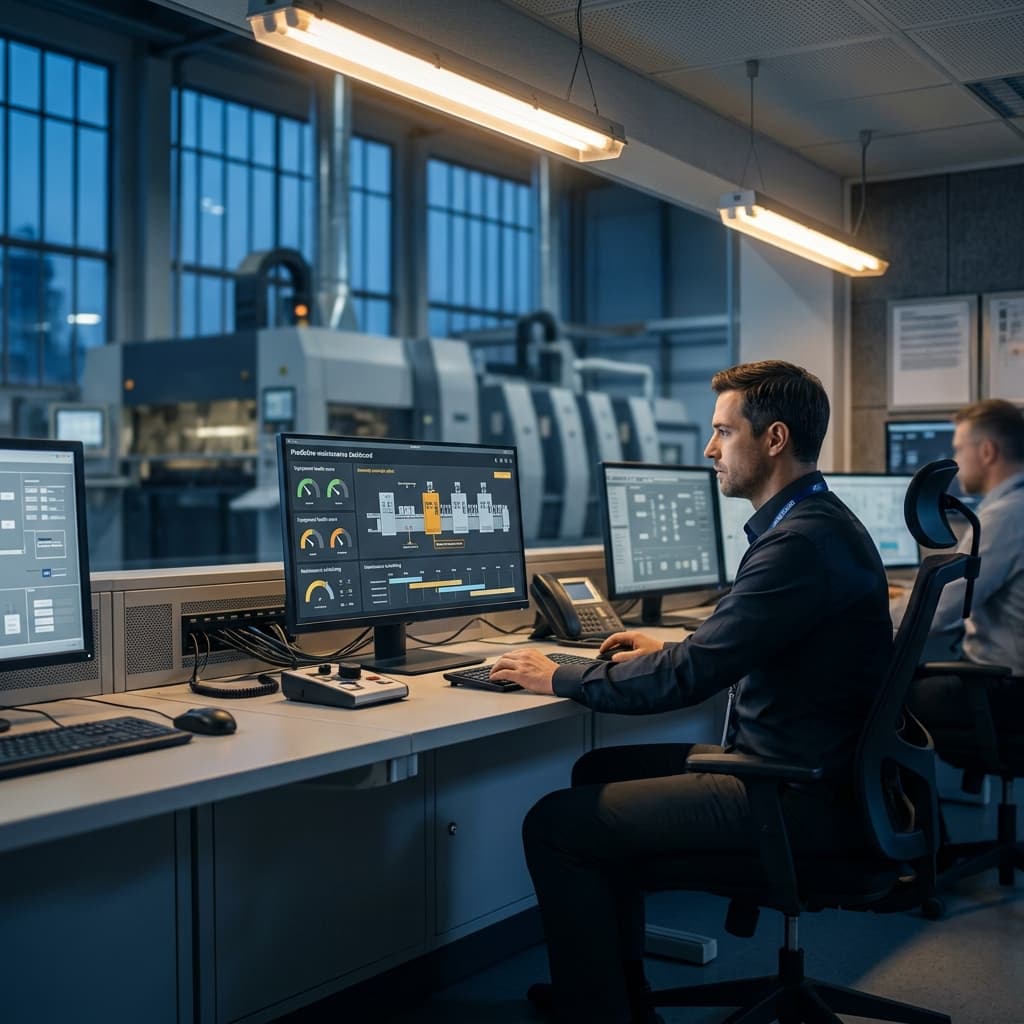 Manufacturing
AI-Powered Predictive Maintenance Solution for the Manufacturing Industry
The manufacturing industry faces unexpected equipment failures and costly downtime. This case study covers an AI-powered predictive maintenance solution.
Read more ↗Manufacturing AI Platform Capabilities
Our manufacturing AI solutions combine plant-floor data integration, vision intelligence, and optimization engines built to operate reliably in industrial environments.
Historian & SCADA Connectivity
Pulls time-series data directly from plant historians and SCADA systems without disrupting existing control infrastructure.
Edge Data Processing
Processes sensor and vision data at the edge to reduce latency and limit bandwidth demands on plant networks.
IIoT Sensor Integration
Connects vibration, temperature, acoustic, and pressure sensors into a unified data pipeline for analysis.
ERP & MES Connectivity
Synchronizes AI insights with enterprise resource planning and manufacturing execution systems for consistent operational records.
Data Quality Management
Cleans, validates, and contextualizes plant floor data to support reliable model performance.
Legacy Equipment Compatibility
Supports data capture from older equipment through retrofit sensors and protocol adapters, avoiding costly hardware replacement.
Defect Detection Models
Identifies surface, dimensional, and assembly defects trained on your specific products and materials.
Real-Time Line Monitoring
Analyzes video feeds at line speed to flag quality and process issues as they occur.
Automated Root-Cause Tagging
Links detected defects back to process parameters and equipment conditions to support faster root-cause analysis.
Continuous Model Retraining
Improves detection accuracy over time as new inspection data and edge cases are captured.
Multi-Camera Coordination
Aggregates data across multiple inspection points to build a complete quality picture for each unit produced.
Compliance Documentation
Generates auditable inspection records to support quality certifications and regulatory documentation.
Constraint-Based Scheduling
Optimizes production sequences against machine capacity, labor, and material constraints in real time.
Demand Forecasting Models
Projects SKU-level and plant-level demand using historical, market, and supply chain signals.
Digital Twin Simulation
Tests process and scheduling changes in a virtual environment before implementation on the physical line.
Energy Optimization Algorithms
Identifies opportunities to reduce energy and resource consumption without compromising output.
Scenario Planning Tools
Models the operational impact of disruptions, demand shifts, and capacity changes before they happen.
Dynamic Re-Optimization
Automatically adjusts plans as conditions change, reducing manual replanning effort for production schedulers.
Our Approach to Manufacturing AI Development: From Plant Assessment to Scaled Deployment
Manufacturing environments carry operational risk that general-purpose AI development approaches don't account for. Our process is built around plant realities: legacy systems, safety requirements, and the cost of production downtime.
- 1
Plant & Process Assessment
We begin by understanding your production processes, existing systems, data availability, and operational priorities to identify where AI can deliver the most measurable impact.
- 2
Use Case Prioritization & Roadmap
We work with operations and engineering leadership to prioritize use cases based on operational impact, data readiness, and implementation complexity, establishing a phased roadmap rather than a single large deployment.
- 3
Data Infrastructure & Integration Planning
Our team designs the data pipelines needed to connect historians, SCADA systems, sensors, and cameras to the AI platform, accounting for network constraints and legacy equipment on your plant floor.
- 4
Model Development & Training
We develop and train AI models using your production data, equipment history, and quality records, validating performance against real operating conditions rather than idealized test data.
- 5
Pilot Deployment on the Line
New AI systems are piloted on a defined line or process area, running alongside existing procedures so operations teams can validate accuracy and build confidence before wider rollout.
- 6
Integration with Plant & Enterprise Systems
We integrate validated AI solutions with MES, ERP, maintenance management, and quality systems so insights translate into work orders, schedule adjustments, and reporting without manual re-entry.
- 7
Scaled Rollout Across Lines & Facilities
Once proven, we help scale successful pilots across additional lines, shifts, and facilities, adapting models to account for equipment and process variation between sites.
- 8
Ongoing Monitoring & Model Refinement
After deployment, we provide continuous monitoring, retraining, and performance tuning to keep models accurate as equipment ages, products change, and production conditions evolve.
Build a Manufacturing AI Roadmap With Us
Get in touch ↗Traditional Plant Operations vs. AI-Augmented Operations
Manufacturers weighing an AI investment often ask what actually changes on the floor. Here's how core operational functions typically shift once AI is embedded into daily workflows.
| Comparison Factors | Traditional Approach | AI-Augmented Approach |
|---|---|---|
| Equipment Maintenance | Fixed-interval or reactive maintenance based on calendar schedules or breakdowns | Condition-based maintenance triggered by predictive models analyzing real equipment signals |
| Quality Inspection | Manual visual checks limited by inspector fatigue, line speed, and sampling rates | Continuous vision AI inspection at full line speed with consistent detection standards |
| Production Scheduling | Manually built schedules updated periodically, slow to adapt to disruptions | Continuously re-optimized schedules that respond to changing constraints in near real time |
| Demand Planning | Statistical forecasts based primarily on historical sales trends | Forecasts incorporating market signals, supply chain variables, and demand patterns beyond historical averages |
| Process Changes | Changes tested directly on the physical line, carrying production risk | Changes simulated in a digital twin before physical implementation |
| Safety Monitoring | Periodic manual safety audits and incident-driven reviews | Continuous vision-based monitoring that flags unsafe conditions as they occur |
Why Manufacturers Choose Antier for AI Development
Manufacturing leaders choose Antier because we understand that plant floor AI has to work within operational constraints most software vendors never encounter.
Industrial Systems Expertise
Our team has experience integrating with SCADA, PLC, MES, and historian systems commonly found in manufacturing environments, reducing the risk of disruption to existing production infrastructure.
Vision AI & Sensor Data Depth
We bring deep experience building computer-vision and sensor-based AI models trained on real production data, rather than generic models retrofitted to industrial use cases.
Operational Risk Awareness
We design and deploy AI systems with an understanding of production downtime costs, safety requirements, and change-management realities specific to plant environments.
Phased, Low-Disruption Deployment
Our pilot-first deployment approach validates AI performance alongside existing processes before asking operations teams to rely on new systems for critical decisions.
Cross-Facility Scalability
We build AI solutions designed to scale across multiple lines and facilities, accounting for the equipment and process variation that exists between plants.
What Influences Manufacturing AI Development Cost
The cost of manufacturing AI development depends on your plant's data readiness, the complexity of the use cases you prioritize, and the scope of systems integration required. We evaluate these factors before scoping any engagement.
Data & Sensor Readiness
Plants with existing historian data, connected sensors, and digital quality records typically require less upfront investment than facilities that need new sensor infrastructure before AI development can begin.
Use Case Complexity
Predictive maintenance for a single equipment class requires less development effort than a multi-use-case deployment spanning maintenance, quality, and scheduling across several production lines.
Systems Integration Scope
Connecting AI solutions to SCADA, MES, ERP, and maintenance management systems adds development effort proportional to the number and complexity of these integrations.
Vision AI Training Requirements
Computer-vision quality models require labeled defect data specific to your products; the volume and variety of training data needed affects both cost and development timeline.
Facility & Line Coverage
Deploying AI across a single line differs significantly in cost and scope from a rollout spanning multiple lines, shifts, or facilities with varying equipment configurations.
Compliance & Documentation Needs
Regulated manufacturing environments, such as pharmaceutical or food production, may require additional validation, audit trails, and documentation that affect overall project scope.
Ongoing Model Maintenance
Many manufacturers include ongoing monitoring, retraining, and support in their engagement to keep models accurate as equipment, products, and processes evolve over time.
Technologies Powering Our Manufacturing AI Solutions
Our manufacturing AI development is backed by a technology stack built for industrial data volumes, edge processing requirements, and integration with plant-floor systems.
AI & Computer Vision Frameworks
Industrial Data Protocols
Edge Computing Platforms
Backend Technologies
Databases & Time-Series Storage
Cloud Platforms
MES & Historian Integration
DevOps & Monitoring
Get a Manufacturing AI Development Cost Estimate
Request a consultation ↗Security, Compliance & Industrial Standards Behind Our Manufacturing AI Solutions
Manufacturing AI operates at the intersection of IT and operational technology, which requires security and governance practices designed for industrial environments, not just enterprise software.
OT/IT Security Practices
We follow security practices aligned with operational technology environments, helping protect production networks, control systems, and sensor infrastructure from the added exposure that connected AI systems can introduce.
IEC 62443 Aligned Practices
Our approach to industrial system integration reflects principles from IEC 62443 guidance on securing industrial automation and control systems throughout the AI development lifecycle.
ISO 27001 Aligned Practices
We incorporate information security management practices inspired by ISO/IEC 27001 to protect the data pipelines and models underlying manufacturing AI solutions.
ISO 9001 & Quality Management Alignment
Our vision AI quality inspection systems are designed to support, not disrupt, existing ISO 9001-aligned quality management processes and documentation requirements.
NIST AI Risk Management Framework
We incorporate risk-aware AI development practices that support governance, accountability, and responsible deployment of AI across production environments.
Regulated Manufacturing Readiness
For pharmaceutical, food, and other regulated manufacturing environments, we support architectures designed to meet validation, traceability, and audit documentation requirements specific to those industries.
Spotlight on Insights
Antier's AI insights help manufacturing leaders understand emerging trends in industrial AI, automation, and digital transformation.
 AI Strategy
What the UAE's 50% Agentic Government Mandate Means for Enterprises?
Discover what the UAE's 50% Agentic AI strategy reveals about the future of enterprise AI. Learn why governance, organizational readiness, and execution matter more than AI adoption alone.
 AI Architecture
RAG vs. Fine-Tuning: A Strategic Guide for Business Leaders
RAG or Fine-Tuning? Go through this blog post to compare business value, costs, governance, scalability, & more factors and choose the right AI architecture.
 AI Development
Every AI Question Business Leaders Need Answered About AI Development in 2026
Explore every important question about AI development in 2026. Learn about AI strategy, costs, security, ROI, and more to make informed business decisions.
Frequently Asked Questions
Start a conversation with Antier
Connect with our consulting and engineering leads to scope your digital transformation from architecture review to production deployment.