
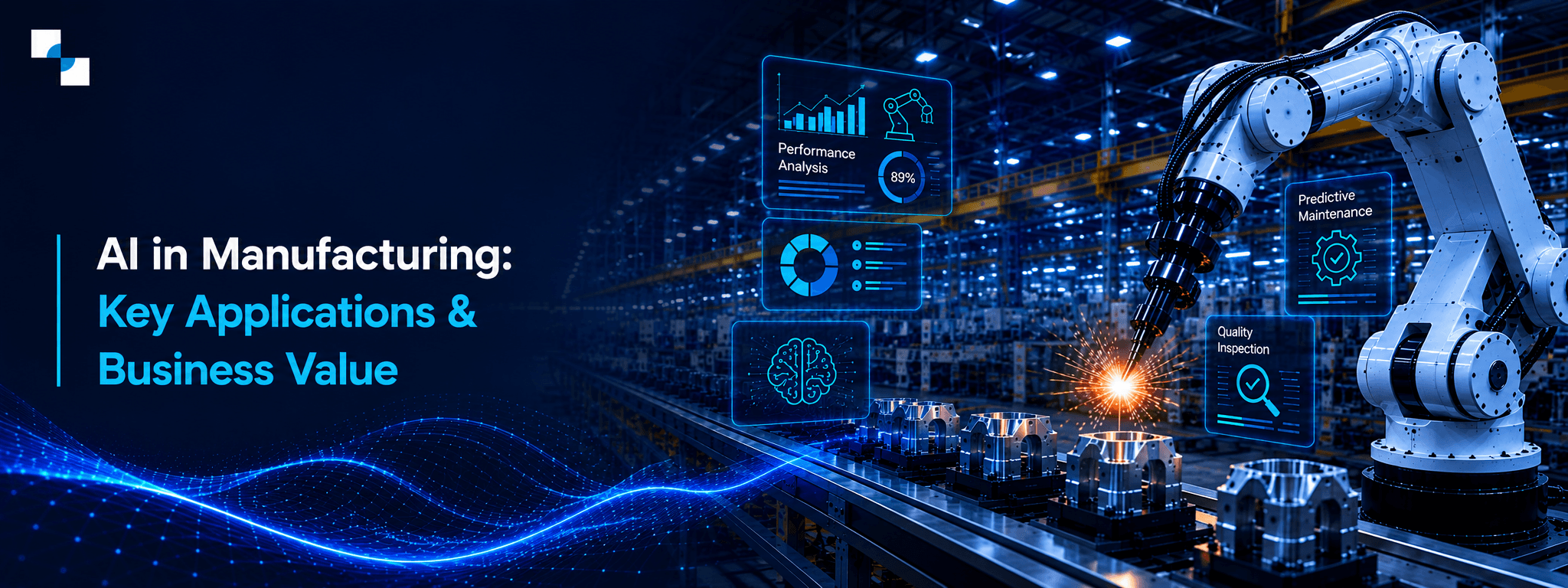
AI in Manufacturing has moved beyond isolated analytics and predictive models. It now covers technologies that help manufacturers understand production conditions, identify problems, support decisions, and automate selected tasks across factory operations.
For manufacturing leaders, the technology itself is not the starting point. The better question is where it can improve an important operational process and produce a measurable business result.
Where AI Fits Into Factory Operations
The strongest AI Applications in Manufacturing are closely tied to processes that affect output, quality, cost, assets, and customer commitments. Instead of applying AI across every function, manufacturers can focus on areas where better prediction, faster decisions, or earlier intervention can produce a measurable result.
Production and process operations
AI for Manufacturing Operations can analyze production data to identify patterns that affect throughput, cycle time, yield, and process stability. Manufacturers can use AI to:
- Detect unusual process behaviour
- Identify factors affecting production output
- Recommend process parameter changes
- Predict production bottlenecks
- Support production scheduling
Quality management
AI Quality Inspection can examine products, images, and process data to identify defects and quality deviations. AI can support:
- Automated visual inspection
- Early defect detection
- Root cause analysis
- Process variation analysis
- Supplier quality assessment
Maintenance and asset management
Maintenance is one of the clearest areas for AI Use Cases in Manufacturing because equipment generates continuous operational data. Predictive Maintenance AI can assess equipment conditions and historical maintenance records to identify signs of potential failure. Applications include:
- Failure prediction
- Condition monitoring
- Maintenance scheduling
- Spare parts planning
- Asset performance analysis
Planning and scheduling
Manufacturers often need to balance demand, available capacity, material availability, labour and production constraints. AI can help planners:
- Forecast demand
- Identify potential bottlenecks
- Evaluate production scenarios
- Adjust schedules when conditions change
- Identify potential delivery risks
Supply chain and inventory
AI Manufacturing Solutions can bring together demand, inventory, supplier and production information to support supply chain decisions. Potential applications include:
- Demand forecasting
- Inventory planning
- Supplier risk analysis
- Procurement support
- Material availability prediction
Energy and resource management
Energy-intensive operations can use AI to identify consumption patterns across equipment, production lines, and facilities. AI can help manufacturers:
- Identify unusual energy consumption
- Forecast energy demand
- Detect equipment consuming excess energy
- Recommend changes to operating schedules
- Track energy consumption per unit
Workforce knowledge and decision support
Manufacturing teams work with technical manuals, maintenance records, quality reports, and standard operating procedures. Generative AI in Manufacturing can make this knowledge easier to access and use. Applications include:
- Natural language access to technical information
- Faster troubleshooting
- Maintenance guidance
- Quality and process support
- Production knowledge retrieval
- Decision support for supervisors and engineers
Planning to Build AI Solutions for Your Manufacturing Operations?
Schedule a free demo ↗How to Prioritize AI Opportunities in Manufacturing?
Manufacturers can identify many potential AI Use Cases in Manufacturing, but not every opportunity deserves immediate investment. The strongest candidates combine a meaningful business problem with usable data, a repeatable decision and a measurable outcome.
Business impact
Prioritize opportunities where improvement can directly affect operating costs, production output, quality or customer commitments.
- Lower operating costs
- Higher production output
- Reduced downtime
- Lower scrap and rework
- Better customer service
Data availability
An AI opportunity is stronger when the required data already exists and can be accessed reliably.
- Machine and sensor data
- Production records
- Quality data
- Maintenance history
- Supply chain data
Decision frequency
AI can create greater value when teams make the same type of decision repeatedly and have enough data to improve it.
- Frequent production decisions
- Recurring maintenance decisions
- Regular quality assessments
- Repeated planning decisions
Operational readiness
The process should have clear ownership and enough consistency to support an AI based approach.
- Defined workflows
- Identifiable process owners
- Consistent operating data
- Clear decision points
- Existing digital systems
Measurable outcomes
The business should be able to establish a baseline and determine whether the AI initiative produced a meaningful improvement.
- Clear baseline metrics
- Defined performance targets
- Measurable business results
- Trackable performance over time
Potential to expand
A strong first use case should offer a practical path to wider adoption across production lines, assets or facilities.
- Repeatable processes
- Reusable data patterns
- Similar operating conditions
- Scope for multi-site adoption
Four Stages of Moving AI From Factory Data to Operational Action
Selecting the right AI opportunity is only the starting point. For AI to create value, its output needs to reach the people and processes responsible for acting on it. A practical manufacturing AI workflow can be understood through four connected stages.
Stage 1: Data to Insight
AI can process information from machines, sensors, production records, quality systems and other operational sources to identify patterns, anomalies and conditions that may require attention. This can help teams identify unusual equipment behaviour, detect changes in production conditions, find patterns behind quality issues and recognize potential production or supply risks.
Stage 2: Insight to Recommendation
Analysis becomes more useful when an AI system turns it into a clear recommendation. Depending on the process, the system may predict a potential equipment issue, flag a quality deviation, identify a production bottleneck, recommend a schedule change or highlight unusual energy consumption. The recommendation should provide enough operational context for the responsible team to understand why action may be required.
Stage 3: Recommendation to Decision
AI does not need to make every operational decision. In many manufacturing environments, it can provide timely information that allows employees to review, approve or modify a recommended action. The system can route recommendations to the right team, provide supporting data, apply predefined decision rules, and record decisions for later review.
Stage 4: Decision to Action
The final stage connects the decision with the process where action takes place. For example, AI may identify a potential equipment failure, the maintenance team reviews the recommendation, assesses the asset, schedules the required work, and records the result. The same approach can support production, quality, planning and supply chain decisions.
AI Technologies That Empower Modern Manufacturing Operations
The right AI Manufacturing Solutions depend on the business problem, available data and level of automation required. Key technologies include:
- Machine learning — Supports prediction, anomaly detection, demand forecasting, equipment monitoring and process analysis.
- Computer vision — Enables automated visual inspection, defect detection and production monitoring through images and video.
- Generative AI — Generative AI in Manufacturing helps teams access technical knowledge, maintenance records, quality information and operational guidance through natural language.
- AI agents — AI Agents in Manufacturing support multi step workflows by interpreting information, recommending actions and working with connected systems under defined controls.
- Multimodal AI — Combines information such as text, images, audio and sensor data to support decisions that depend on multiple data types.
- Digital twins — Create digital representations of assets, production lines or processes to support simulation, scenario analysis and process planning.
- IoT and edge computing — Capture and process machine and sensor data closer to the production environment, supporting applications that require timely operational information.
Choose the AI technologies that match your manufacturing requirements
Contact our AI experts ↗How AI Connects With Existing Factory Systems
AI Manufacturing Solutions need access to the systems that already manage production, quality, maintenance, inventory, and business operations. Connecting AI with these systems gives models the operational context needed to produce useful insights and recommendations.
- ERP for Business and Supply Chain Data — ERP systems provide information on orders, inventory, procurement, suppliers and financial operations. AI can use this data to support forecasting, planning and supply chain decisions.
- MES for Production Data — MES platforms provide information on production schedules, work orders, output and process activity. AI can use this information to identify production patterns, bottlenecks and performance issues.
- QMS for Quality Data — QMS platforms hold inspection results, defect records, and quality information. AI can analyze this data to identify recurring quality problems and support AI Quality Inspection.
- CMMS for Maintenance Data — CMMS platforms contain equipment records, maintenance history, and work orders. Predictive Maintenance AI can use this information alongside machine data to identify potential equipment issues and support maintenance planning.
- SCADA and IoT for Machine Data — SCADA and IoT systems provide information from machines, sensors and production environments. AI can analyze this data to detect anomalies, monitor conditions and identify changes that require attention.
- PLM for Product and Engineering Data — PLM systems contain product designs, engineering information and lifecycle records. AI can use this information to support engineering analysis, product decisions and knowledge retrieval.
Where AI in Manufacturing Is Heading Next
- AI agents will take on more production decisions — 74 percent of manufacturing leaders expect AI agents to manage 11 to 50 percent of routine production decisions by 2028.
- Physical AI will move closer to the factory floor — 75 percent of manufacturers expect Physical AI to have a significant or transformational impact on assembly and manufacturing operations.
- AI will become more connected across operations — The World Economic Forum's Global Lighthouse Network now includes 238 leading industrial sites, with its 2026 research highlighting a shift toward end-to-end intelligence, human-machine collaboration and more connected industrial operations.
- Human and AI collaboration will become a core operating model — 86 percent of employers expect AI and information processing technologies to transform their businesses by 2030, while 63 percent identify skills gaps as a major barrier.
Turn AI opportunities into operational solutions
Get in touch ↗Conclusion
AI in Manufacturing is becoming a practical business capability across production, quality, maintenance, planning and supply chain operations. The priority is to identify the right opportunities, connect AI with existing workflows, and measure its impact against meaningful business outcomes.
Turning these opportunities into production-ready systems requires the right manufacturing expertise, AI capabilities, and understanding of factory operations. Working with a specialized Manufacturing AI Development Company can help businesses move from identifying opportunities to building and deploying solutions that fit their operational needs.

Start a conversation with Antier
Connect with our consulting and engineering leads to scope your digital transformation from architecture review to production deployment.